
809 Epsom and Ewell households on council tax support would get less under East Surrey's draft scheme from April 2027, and 1,070 more. Comment by 3 December.
Every working-age household in Epsom and Ewell that gets help with its council tax would see that help change from April 2027 under a draft scheme now out for consultation. 1,070 would get more and 809 would get less. Not one of the borough’s 1,879 claimant households would be left where it is.
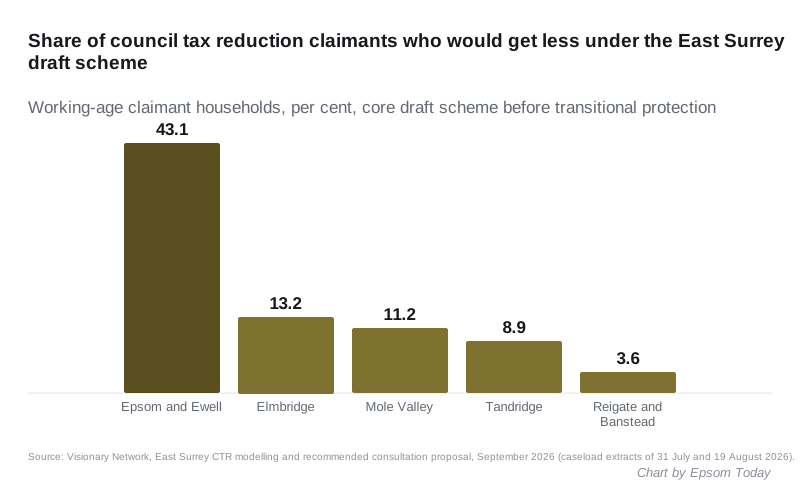
That is the finding of the modelling published with the consultation, which opened on 7 October and closes on 3 December 2026. No other part of East Surrey is hit as hard. In Reigate and Banstead, 94 per cent of claimants would see no change at all.
Why it is happening
Surrey’s 11 district and borough councils and the county council are being replaced on 1 April 2027 by two new councils, East Surrey and West Surrey. Epsom and Ewell goes into East Surrey, along with Elmbridge, Mole Valley, Reigate and Banstead, and Tandridge.
Each of those five councils runs its own council tax reduction scheme for working-age people. The new council has to run one. The council’s announcement says no final decisions have been made, and current awards stay in place while the consultation runs. Pension-age claimants are not affected: their support follows national rules.
Why Epsom and Ewell is different
Epsom and Ewell is the odd one out. Since April 2021 it has run a Council Tax Income Discount, which puts each household into one of four bands by monthly income and household size. The council’s scheme page sets out the rules:
- the discount is 80%, 65%, 50% or 40% of the bill
- everyone pays at least 20%, so 80% is the most anyone gets
- you cannot claim with £6,000 or more in savings
The other four councils all use a conventional means test, where help tapers away gradually as income rises. The draft East Surrey scheme does the same. So Epsom and Ewell is the only borough where the whole method of working out an award changes.
The council says the banded scheme was chosen because it is simpler, and because bills are “much less likely to change every month” when Universal Credit payments go up and down.
What the draft scheme proposes
The consultation FAQs list the main rules:
- support of up to 100% of the bill, with no council tax band cap
- a savings limit of £16,000
- a standard means test, where help falls by 20p for every £1 of income above what the household is assessed to need
- a flat £10 a week deduction for each other adult living in the home, such as a grown-up son or daughter
- no award at all if it would come to less than £5 a week
- backdating of up to three months
- a Minimum Income Floor for self-employed claimants after a 12-month start-up period
- time-limited transitional protection for some existing claimants facing a significant cut
Some of that is better for Epsom and Ewell claimants than the current rules. The maximum rises from 80% to 100%. On a band C bill of £2,249.64, the 20% every claimant pays now is £449.93 a year. The savings limit goes up from £6,000 to £16,000.
Other parts are worse for some. Epsom and Ewell charges a flat £38 a month for each other adult in the home, according to the comparative analysis published alongside the consultation. The draft’s £10 a week works out at about £43 a month. The borough has 425 claimant households with at least one other adult living with them.
Who would lose out
The modelling paper, written by the consultancy Visionary Network, splits the 809 Epsom and Ewell households who would get less into two groups:
- 695 lose because of the change in how awards are worked out
- 114 lose because of the new £10 a week deduction for other adults
Everywhere else in East Surrey, every household that loses does so because of that £10 deduction. The 695 method losses are all in Epsom and Ewell.
Most of them are on the current scheme’s lowest discount. Of the 695:
| Current discount band | Households that would get less |
|---|---|
| 40% | 469 |
| 50% | 104 |
| 65% | 58 |
| 80% | 64 |
The paper explains why. The 40% band works as “a substantial floor”: a household keeps 40% off its bill until its income leaves the band altogether. Under a taper, help shrinks with every extra pound earned. The paper says the households losing out are “concentrated among working families with children”.
That matters more here than anywhere else in East Surrey. The comparative analysis shows that 62.8% of Epsom and Ewell’s claimant households include children and 53.6% are in work. In Mole Valley, only 18.7% are in work.
Will there be protection?
The modelling paper says the 695 losses “support consideration of time-limited transitional protection”. The FAQs describe it as temporary extra support while people adjust.
But nothing about it is settled. The FAQs say the protected group, how long it lasts, how it tapers away and what it costs “have not yet been decided”. The headline modelling does not include it. The consultation asks for views on it.
The FAQs also say a separate hardship route will remain for exceptional cases.
Across the whole of East Surrey, the draft scheme is modelled to cost £18.794 million a year, against £19.188 million for the five current schemes: £394,000 less.
How to have your say
The consultation runs until 11.59pm on 3 December 2026. The East Surrey version is at surreylgrhub.gov.uk/ctrs-eastsurrey.
- Anyone can respond, not only people who claim.
- Paper and postal questionnaires, telephone help, email and accessible formats are available.
- Questions go to ctrseastsurrey@surreylgrhub.gov.uk.
- The FAQs say a response will not affect your claim or your council tax account.
East Surrey shadow councillor Andy Burton, portfolio holder for finance and resources, said: “Council Tax Reduction is an important source of financial support for eligible residents, and I would strongly encourage anyone affected to take part in the consultation.”
A final report is due at a Full Council meeting in January 2027, and the new scheme would start on 1 April 2027.
What it means for you
- If you get Council Tax Income Discount now, nothing changes before April 2027. Your current award continues under the borough’s rules until then.
- If you are on the 40% band and working, you are in the group most likely to lose. That is where 469 of the 695 method losses sit.
- If your household is on a low income with no other adults at home, you may gain. The maximum rises from 80% to 100%.
- If a grown-up child or other adult lives with you, the flat deduction rises from £38 a month to about £43.
- If you have between £6,000 and £16,000 in savings, you could become eligible for the first time.
- The consultation cannot tell you your own new award. The FAQs say individual figures depend on the final scheme and on 2027/28 bills.
- Band charges for this year are on our Epsom council tax bands page.
Sources: Epsom and Ewell Borough Council news release, 7 October 2026; Epsom and Ewell Council Tax Income Discount page; East Surrey CTR consultation FAQs, comparative analysis (20 September 2026) and modelling paper (September 2026), all read on 13 October 2026.
Have your say